
Intraoral scanners have been around for decades. The first commercial units are pre-millenium. Not all patients agree that digital impressions are more comfortable than physical impressions.
There have certainly been improvements since the first CEREC system was sold in 1987 [1]. The issue is the scan head. After 40 years on the market, is it time to disrupt the disruptor?
User Need
Increased patient comfort requires a smaller device. Form factor inspiration is the mouth mirror.
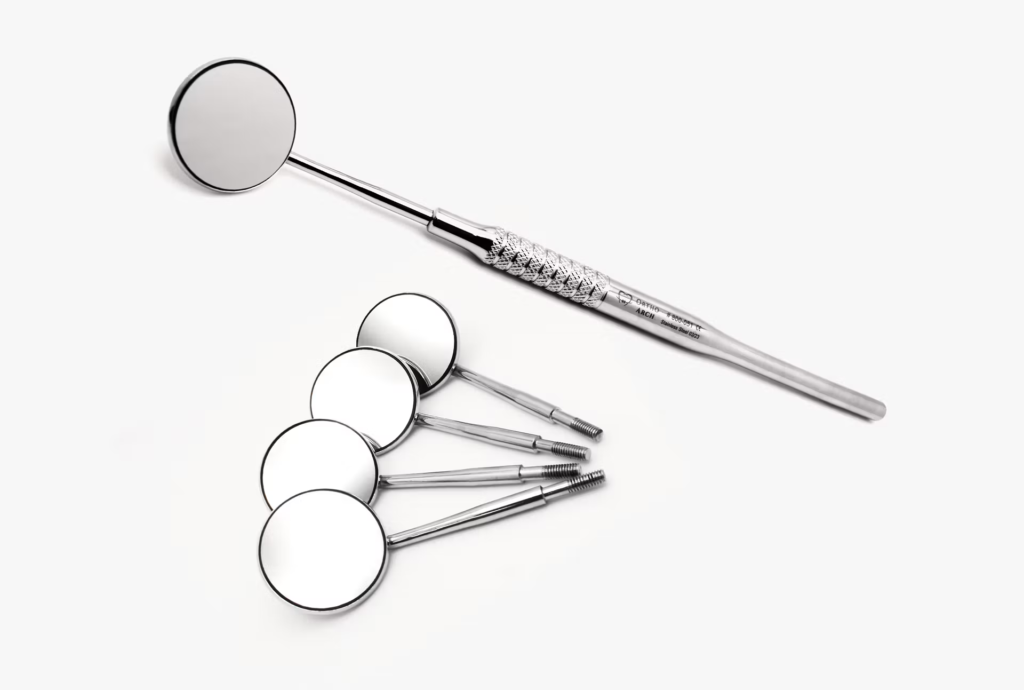
US Market Assumptions
- 200,000 dental offices [2]
- 60% have a scanner [3]
- ASP for mid-range product is $30k – $45k
- expected scanner lifetime of 7 years
- subscription fees can be $2k – $10k per year
Market Opportunity
200k x 0.6 x $30k / 7 years > $500M per year
Implementation Notes
Cameras
Traditional optics provide off-the-shelf hardware for proof-of-concept.
Gaussians
On chip geometry processing [4].
LIDAR
A stretch goal for the required scale & accuracy.
Metamaterials/surfaces
A technology that delivers thin optics should be applicable.
Time-of-flight
Can this algorithm be used at millimeter scale?
Ultrasound
I recently had an electrocardiogram and learned about the limitations of ultrasound vis-à-vis bone. Might be useful as a companion technology.
References
[1] – https://www.cadcamhero.com/blog/47955-cerec-milestone-timeline
[2] – https://www.ada.org/resources/research/health-policy-institute/dentist-workforce
[3] –
[4] – https://news.mit.edu/2026/new-chip-could-help-tiny-robots-traverse-complex-environments-0623